ENG
 Feedback
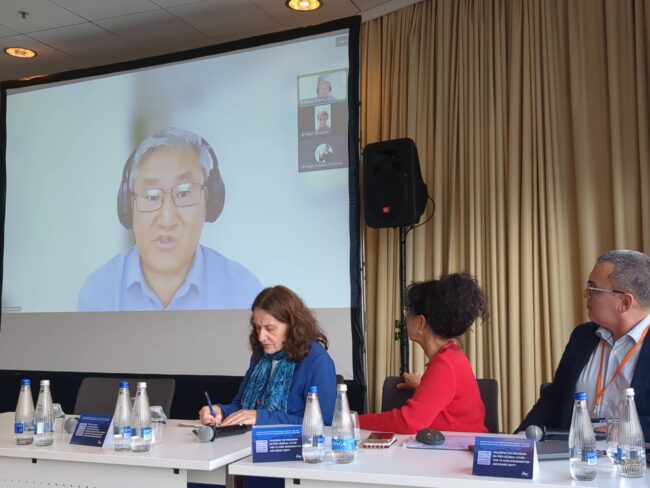
At the annual OSCE Human Dimension Conference, human rights defenders and Indigenous rights activists discussed how a human rights-based approach applies to ideas about a post-colonial future. ADC Memorial organized the discussion. Its aim was to bring a stronger human rights perspective to a debate already under way among Indigenous activists, about rejecting Russian colonial patterns and respecting every people’s cultural, economic, environmental and political rights. Representatives of the peoples of the Caucasus, the Urals and Siberia are speaking out more and more about creating independent national republics based on local cultural and political heritage. Participants noted that, as this happens, the rights of other groups living in these regions also need special attention. These include small-numbered Indigenous peoples and other minorities.
The activists who spoke agreed that the political future must rest on democratic, inclusive approaches. They also agreed on the need to work out how to guarantee equal opportunities and protection from discrimination for peoples who cannot create independent states. These peoples need their rights protected within existing political entities, or possibly within future ones.
Indigenous participants in the discussion were:
- Ruslan Valiev, Aspects of Bashkortostan
- Maria Ochir-Goryaeva, historian and decolonial activist from the Republic of Kalmykia
- Vyacheslav Shadrin, expert on the rights of small-numbered Indigenous peoples and a representative of the Yukaghir people (via Zoom)
- Taulan Salpagarov, Indigenous Peoples Global Unity (via Zoom)
They were joined by Natalia Sineaeva-Pankowska (via Zoom), a human rights defender from the “Never Again” Association, and Stephania Kulaeva, an expert at ADC Memorial.
The speakers’ contributions complemented one another. Maria Ochir gave an overview of the complex, multi-ethnic patchwork within the borders of today’s Russian Federation. Ruslan Valiev called for more regular and closer cooperation among all peoples suffering from Moscow’s colonial pressure. Representatives of smaller peoples then spoke by Zoom, as they could not travel to Warsaw.
Vyacheslav Shadrin spoke about the rights of the Yukaghirs and other Indigenous peoples of the North and Siberia. Taulan Salpagarov spoke on behalf of the Alans, who have suffered for centuries under the Russian Empire, the USSR and today’s Russian Federation, and also on behalf of other peoples of the North Caucasus. Natalia Sineaeva-Pankowska stressed the need to approach peoples’ history honestly and study it carefully. She also spoke about keeping alive the memory of the terrible price that oppressed groups paid at the hands of conquerors and oppressors. Sadly, the people of Ukraine are paying that price today. All the speakers raised this repeatedly and condemned Russia’s aggression.
Eskender Bariiev also spoke during the discussion. He is a human rights defender, head of the Crimean Tatar Resource Center and a member of the Mejlis of the Crimean Tatar People. He said that protecting Indigenous peoples’ rights also matters for Ukraine. In particular, it is important to keep defending the rights of Ukraine’s Indigenous peoples who live in the temporarily occupied territories.
ADC Memorial thanks all participants and listeners. It also thanks everyone ready to join in jointly reflecting on the colonial past and present. The goal is that, in the future, human rights and the rights of peoples are respected, whatever political situation, borders or countries that future brings.
The full discussion is available on video (in Russian).
The side event will be organized as part of the project “Indigenous Peoples’ Rights for a Democratic Future”, which is being implemented by INFOE (Institut für Ökologie und Aktions-Ethnologie e.V.), ICIPR (International Committee of Indigenous Peoples of Russia), the Never Again Association and the ADC Memorial, with the support of the German Federal Foreign Office.