


There is, oddly enough, a kind of blunt honesty in the decision of the Chelyabinsk Central Court to ban an Oscar-winning film about the militarisation of schoolchildren in the town of Karabash. The prosecutor’s complaint was disarmingly direct: the film expresses a “negative attitude” towards Russia’s war and its authorities. The court went further, invoking “terrorism propaganda” because of a white-blue-white flag — long designated extremist by the state — seen in the office of the film’s protagonist and co-author, Pavel Talankin. At least the pretence is gone. In today’s Russian legal vocabulary, the so called extremism and terrorism are interchangeable labels, as well as their “propaganda.” The film was banned for exactly what it shows: Talankin, coyly introduced as “Mr Nobody,” is read as being “against Putin” — and that, in itself, is enough, because such a “negative attitude” is banned.
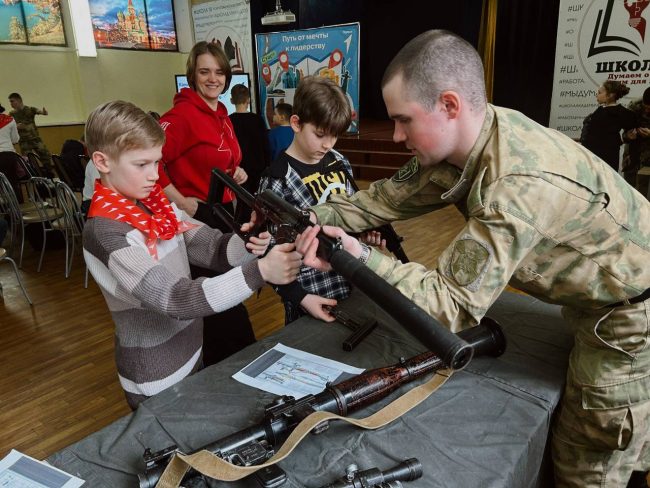
The ban was not immediate; For more than a year, the film travelled the international festival circuit, collecting awards and gathering momentum as an Oscar contender, before ultimately winning. Throughout this, the Russian authorities remained conspicuously silent, as if unsure how to respond. When they did, the reaction was as clumsy as it was revealing. The so called Presidential Council for Human Rights filed a complaint — strangely enough, not with domestic institutions, but with the UNESCO — claiming that the film violated the rights of minors by showing their faces. It is hard to read this as anything other than cynical theatre. It is hard to believe that even people as inexperienced in children’s rights as those who are appointed in this “human rights body” do not understand that UNESCO is not the most suitable place to study their claims. If this were a body genuinely concerned with children’s rights, it might have turned its attention to the Ministry of Education, whose cynical role in orchestrating the very scenes captured in the film is difficult to overstate. As Talankin himself put it, the filming followed a script effectively authored by the Ministry: every line, every gesture, every reaction preordained. “It was a fully scripted lesson, a fully scripted presentation — down to the minute: which teacher should say what, how the children should look, and how they should respond”, — Talankin said in an interview. What the film captures is not improvisation, but choreography — the staging of militarised childhood.
The outrage over children’s visibility on screen rings especially hollow in this context. Everyone, including the children themselves (their opinions are rarely asked, but they are in fact even more important than those of adults — parents, teachers, or other adults crushed by propaganda and afraid for themselves), and all the other participants in the filming, understood that this was not being filmed for “home viewing,” although, of course, they did not know about the future international film that would make them famous.
There are no scenes in the film where children try to hide from the camera pointed at them or, in tears, ask for the filming to stop. But in the film “Betrayal,” shown on Russian television shortly before the “scandalous” (in the view of the Human Rights Council) awarding of the Oscar, such scenes do appear. It also features a member of the Human Rights Council, Marina Akhmetova (was it not she who drafted the complaint to the UNESCO?). In “Betrayal,” Akhmetova comments on the arrests of teenagers accused of terrorism: her speech is inserted precisely between scenes of the arrest of a boy suspected of setting fire to a relay cabinet on the railway. The teenager’s face is shown in the closest close-up, as are the bewildered faces of his parents scolding the boy (“Didn’t you know you weren’t allowed to do that?”). It is highly unlikely that these people gave permission to the propagandist Andrei Medvedev or to the Human Rights Council member Marina Akhmetova to publish video filmed at the tragic moment of their son’s detention.
Even if the parents did give such permission, it is entirely obvious that their understanding of what is happening (or rather, their lack of understanding) in no way corresponds to the position of the young man himself, who stubbornly turns away from the camera, looking only into his mother’s eyes, from whom he is now being taken away for years. He faces up to ten years in prison (as a security officer’s voice off-screen says) — he will answer for his decision and his “expression of a negative attitude” himself, yet for some reason others are expected to give permission for filming and publishing his image at the moment of his detention?..
This is how the experts from the Human Rights Council understand the “rights of minors.” This is also how the Russian authorities understand them — a prison sentence for “justifying terrorism” (that is, for example, for a white-and-blue ribbon) applies from the age of fourteen, while showing their faces up to the age of eighteen requires permission from the oldest and wisest.
The film about “betrayal” is precisely about the young — about those whom it neatly refers to as the “juvenile strata’s of the population.” It shows both those who are still awaiting trial and those who have already been sentenced to 17–18 years or more. A menacing voice-over declares that the arson of relay cabinets is most often carried out by these “juvenile strata’s,” that criminal responsibility begins at fourteen, and that the “sentence may extend up to life imprisonment” (here again they are lying — minors cannot yet be given life sentences).
Yet even these harsh measures do not seem sufficient to the film’s “experts” in their fight against the “juvenile strata’s ”: the ex-spy Bezrukov calls openly for the death penalty, stating with apparent expertise that “any recruitment takes place on the basis of a sense of life.” It turns out that some people have found this “sense of life” in “protecting something, like animals,” and here the experienced intelligence officer concludes: “if a person associates with such people, then they must have something in common.” The authorities vigilantly monitor those who “associate” and have already convicted thousands of young people over the past three years (this information from an FSB report is also cited in the film). The rest are being intimidated and have their minds flooded with lies promoting war.
Returning to the Talankin–Borenstein film banned in the Russian Federation, I would only add that this film is important for Western audiences. It has been awarded in Britain, the United States and other countries precisely because the horror of the militarisation of schoolchildren is shown there in the most accessible, most explicit way — so that even those who are extremely far removed from this reality can understand it. Those who closely follow what is happening to children in Russia and in the occupied territories of Ukraine — and even more so those who live there — will find nothing surprising in this. Moreover, the situation is changing every year and every month, as demonstrated by the latest study by the “Ne Norma” project and online media “Verstka”, which addresses the issue of the use of children for military purposes.
As it turns out, in hundreds of Russian schools children are no longer simply made to absorb propaganda and, in line with the Ministry’s script, to “watch and react,” but are directly made to produce items used in war and for military purposes. Researchers found that “in a school in the village of Uzyan in the Republic of Bashkortostan, children make scrubbing pads and weave tactical bracelets for participants in the ‘special military operation’.” It is known that “in field conditions, military personnel use these bracelets for the rapid securing and camouflage of equipment, and for creating traps or snares” — that is, these tactical bracelets may serve to kill people on the front line. Teachers, publishing their reports, explain: “Such work allows them to feel their involvement in the common cause of supporting the defenders and fosters patriotic feelings in children.” At times, by the teachers’ own admission, children tried to refuse “because of their attitude towards the special military operation,” but they were “persuaded, coaxed… Under collective pressure, they gave in.”
Talankin once took part in filming militarised lessons “for reporting to the Ministry”; now, for such reports, photographs are published of children (and not always with their faces concealed) making tactical bracelets, weaving camouflage nets, and sewing clothing for those who are going to kill, conquer and destroy Ukraine. Meanwhile, those children who, “on the basis of a sense of life,” speak out against this are sentenced to ten years or more, as shown in the film “Betrayal”.
Stephania KULAEVA
First published on the Radio Svoboda blog