ENG
ENG Feedback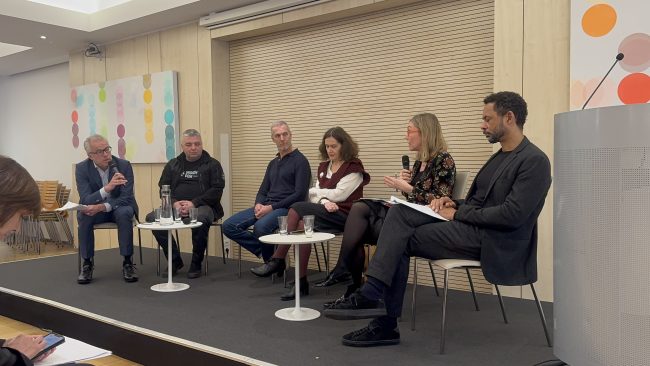
An expert discussion “War crimes committed by Russia against Ukraine: Joint work of human rights organizations towards truth and justice” took place on 1 December 2025 in Brussels. The event gathered diplomats, members of the European Parliament, human rights defenders and representatives of international organizations. It marked the kick of the project (funded by the EU) and showed the results of human rights cooperation.
The discussion was organised by Kharkiv Human Rights Protection Group, Center for Civil Liberties, Anti-Discrimination Centre Memorial – Brussels, the Mission of Ukraine to the EU and the Mission of Norway to the EU, and moderated by Thijs Reuten, Member of the European Parliament (S&D, Netherlands). The war-crimes documentation work was presented, as well as interventions by Wayne Jordash, Director of Global Rights Compliance Foundation, and Marta Wytrykowska, Deputy Head of Ukraine Division at the European External Action Service.
Presentation of the Report: Torture of Ukrainian Prisoners of War
Mr. Mykhailo Romanov, expert of the Kharkiv Human Rights Protection Group (KHPG) presented key findings documenting torture, inhuman treatment and unlawful detention of Ukrainian prisoners of war in Russian prisons. He emphasized that the KHPG database had already documented nearly 99,000 incidents of international crimes, including war crimes, crimes against humanity and elements of genocide. According to the report, Ukrainian POWs are held in at least 121 detention facilities in the Russian Federation and 15 facilities in temporarily occupied territories. Mr. Romanov stressed that torture was systematic and widespread, affecting all detainees without exception:
“Torture is used against everyone, without exception, throughout the entire cycle of detention. These are not isolated acts, but elements of the system.”
KHPG’s work combines documentation, interviews with victims, verification of evidence, legal qualification of crimes, and support to survivors.
Testimony of Former Prisoner of War Maksym Butkevych
Human rights defender and former prisoner of war Mr. Maksym Butkevych, laureate of the Václav Havel Human Rights Prize 2025, spoke next. Reflecting on the report, he said its findings “contain nothing surprising” to those who survived Russia’s detention system. He noted that many detainees were subjected to forced confessions used for propaganda purposes:
“Russian propaganda needed ‘Ukrainian war criminals’. They had none, so they extracted confessions under torture.”
Maksim Butkevych stressed that independent international monitoring of detention facilities remains critically absent, enabling systematic abuse of Ukrainian prisoners of war and civilians.
“Torture, intimidation and fabricated charges were used systematically. The atmosphere of constant fear was the defining feature of captivity,” Mr. Butkevych stated.
He also underlined the urgent need for international pressure for the release of all prisoners of war and civilian hostages, stressing that exchange and return must be treated as a precondition, not a by-product, of any negotiations.
Intervention of Stephania Kulaeva, ADC Memorial Brussels
Stephania Kulaeva, expert of ADC “Memorial-Brussels”, drew attention to the enormous impact of Russia’s aggression on vulnerable groups. She presented cases involving children and minorities, including abductions, sexual violence, militarization and forced ideological influence in occupied territories.
Stefania underlined:
“The suffering of children on the occupied territories, including such cases as using children as hostages, sexualised violence and exploitation by Russian military, using children for war purposes, still receives insufficient international attention. These crimes must be documented and prosecuted along with all other violations.”
ADC Memorial continues to document violations against children, Roma communities and other groups exposed to heightened risks in occupied territories. Was shown the video artistically presenting documented case of the Romani family with many children, they faced war crimes in the time of occupation in Kherson Province.
Broader discussion: accountability, sanctions and the role of civil society
During the panel, Mr. Wayne Jordash underlined the essential role of Ukrainian civil society organizations in gathering evidence of international crimes, noting that the scale of violations far exceeded the capacity of state institutions alone, he called everybody’s attention to the report of KhHRPG as an important source of evidence of the torture used against POWs and civic hostages captured by Russia.
Ms. Marta Wytrykowska spoke about the EU’s continued commitment to accountability, such as support for the creation of a special tribunal for the crime of aggression, the development of a claims commission, and the extension of targeted sanctions against individuals involved in torture and unlawful detention of Ukrainian POWs.
The discussion reaffirmed the shared determination of Ukrainian and international human rights organizations to pursue justice for victims of Russia’s war crimes and to ensure that these crimes remain visible to the international community.