


At the end of April, New York annually hosts sessions of the United Nations Permanent Forum on Indigenous Issues, an advisory expert body affiliated with the UN Economic and Social Council. The Forum has operated since 2000, and this year marked its 25th session, with a specific theme of ensuring the health of Indigenous peoples, including in situations of conflict. As the UN for a have global dimension, participants bring examples from all over the world — giving a diverse worldwide context.
For some Indigenous peoples, “conflict” means war or clashes between armed groups on their land, forcing them to leave. Others have to tolerate military bases on their territories, while still others enter into open confrontation with extractive companies — often leading as well to the forced displacement of Indigenous communities. Some participants argue that colonization itself should be regarded as a form of “conflict,” given its diverse negative consequences for the health and well-being of Indigenous peoples.
For those Indigenous peoples currently living in the Russian Federation, several aspects of conflict, as understood at the UN, are simultaneously relevant. These include Russia’s war against Ukraine, in which Indigenous peoples have become disproportionately and heavily involved; the unresolved consequences of the colonial policies of the Russian Empire, the USSR, and modern Russia; and the damaging activities of extractive industries.
The paradox, however, is that in Russian state policy toward Indigenous peoples, “conflict” is something that cannot be named — just as the war itself cannot officially be called a war. The propaganda narrative of “national unity” excludes any discussion of the colonial nature of Russian policy past or present: colonialism belongs somewhere among the “Anglo-Saxons,” while Russia supposedly only practiced voluntary integration. A typical expression of the official position is the response given by Igor Barinov, head of the Federal Agency for Interethnic Affairs, when asked how Russia managed to combine tendencies toward “national unity” and “diversity of peoples”:
To understand why these things fundamentally do not contradict each other for us, one probably has to understand how our state was formed. It never pursued colonial policy on a full scale while expanding. The overwhelming majority of peoples and territories that became part of our country sought protection and generally found it. Internal tension ceased there; the benefits of civilization, education, healthcare arrived, as did resources from the central regions. We never treated the outskirts as a metropolis treats colonies. And that is precisely why the peoples joining this large, multifaceted family felt comfortable, because they could, as Ivan Ilyin wrote, speak in their own way, pray in their own way, work in their own way, while the best representatives from the national peripheries were involved in state and cultural development. And that is why even through such global cataclysms as the collapse of the Soviet Union or the fall of the tsarist empire, we remained the world’s largest and one of the most multinational and multiconfessional states. Of course, the role of the state-forming [Russian] people and of the Russian language as the language of interethnic communication is enormous, but the same is the role of state policy, which allowed all these peoples to feel comfortable.
There are many remarkable words and expressions in the speech: the use of “we” in reference to the Russian state across different eras; the notion of a “state-forming” people and language (Russian); idealized distortions about the comfortable lives of peoples in the empire, the “benefits of civilization,” and the ending of internal conflicts; and Ilyin as an “authoritative source.” I would add that at the beginning of the interview quoted, Barinov speaks about continuity: the agency he heads occupies the building of the former People’s Commissariat for Nationalities Affairs, and specifically his office is approximately located where the apartment of the first commissar (Stalin) once was. It is also noteworthy that when defining what used to be called the “Russian civic nation” or “citizens of the Russian Federation,” Barinov uses the word russkiy (“ethnically Russian”) rather than rossiyskiy (“Russian” in the civic sense). Asked, “What is Russia like?” he answers:
It is vast, multifaceted, but strong and respectful toward everyone who considers themselves part of this country, who in this broad sense considers themselves Russian [russkiy]. Again, I keep being drawn back to the events of the special military operation [the official Russian term for the war against Ukraine — author’s note], to the guys fighting there. Look at what is happening. Regardless of nationality, they say: “We are all Russian [russkiye] soldiers.” When every person feels themselves to be Kumyk, Dargin, Avar, Yakut, Balkar, Ingush, or Chechen, while remembering their traditions, customs, culture, respecting their people, but also feeling Russian [russkiye] — therein lies the guarantee of unity and the future of our country.
That’s it — the continuity…
At a time when the peoples of Russia who do not belong to the Russian ethnic majority experience racism and xenophobia, which over recent decades have become a constant background feature of public life and, according to experts, are increasing; when small-numbered Indigenous peoples, suffering from the activities of extractive companies, globalization, and insufficient support measures, remain among the most vulnerable and impoverished groups in the Russian Federation — the mere existence of special legislation on the rights of small-numbered Indigenous peoples (those under 50,000 persons) becomes a trump card that official Russian representatives invariably play on international platforms.
Thus, this year, speaking at the Permanent Forum, Igor Barinov painted a fantastic picture of healthcare provision for Indigenous small-numbered peoples, involving “ships equipped with medical devices, all-terrain vehicles, heavy-duty trucks capable of operating in hard-to-reach and remote territories, where projects are underway to connect nomadic households to satellite internet and telemedicine services are being introduced.” As for conflict — without specifying which conflict or its harm to health — he mentioned Western sanctions, “which include bans on supplying rare medicines necessary for nomadic and semi-nomadic groups, as well as amphibious and ground all-terrain vehicles that form the basis of their means of subsistence in the taiga and tundra.”
According to Barinov, responsibility for the deterioration of Indigenous peoples’ health under conflict conditions lies with Ukraine and its “water and energy blockade of the Crimean Peninsula, which undermined the traditional livelihood system of the Crimean Tatars.” This argument is not entirely trivial, since Crimean Tatars are recognized as an Indigenous people under a special law passed not by Russia but by Ukraine — truly, the Russian delegation found every possible pretext useful. Suleiman Mamutov (Ukraine), an expert at the Permanent Forum, pointed out the cynicism of this statement. In reality, the “livelihood system” of the Crimean Tatars and other Indigenous peoples of Crimea has been undermined by something entirely different: the occupation of their traditional territories, the imposition of a harsh totalitarian administrative regime, and the enforcement of numerous repressive laws. In a recent speech in Brussels, Eskender Bariyev (the Crimean Tatar Resource Center) emphasized that the persecutions are directed not simply against Crimean Tatar activists, but against the entire people as bearers of political agency and a distinct identity.

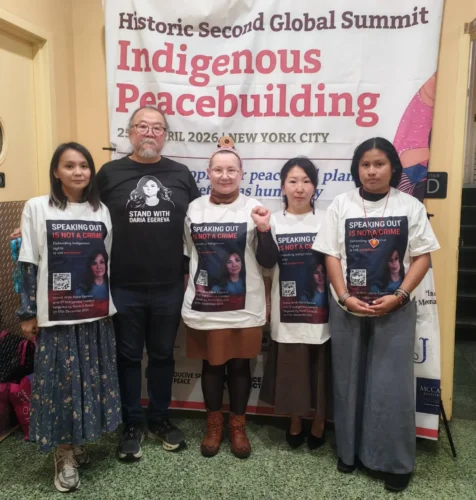
Those who had been forced into exile — some quite recently and urgently, following a wave of detentions, searches, and interrogations that swept across the Russian Federation in December 2025 — spoke in New York about repression against defenders of Indigenous rights as a systemic phenomenon in modern Russia. Olga Kostrova, one such recent emigrant, speaking on behalf of the International Committee of Indigenous Peoples of Russia (ICIPR), stressed that dozens of activists had been targeted for repression because of their participation in UN international platforms created specifically for Indigenous peoples. Pavel Sulyandziga, head of the Batani Foundation and an ICIPR member who has lived in forced exile for several years, spoke painfully about how Russian authorities use loyal activists to promote their position at the UN while criminalizing the work of independent leaders and experts. The activists called for the immediate release of Darya Yegereva and Natalia Leongardt, arrested in Moscow in connection with the “Aborigen Forum” case: they are accused of participating in the activities of an “extremist” and “terrorist” organization, charges that carry the threat of lengthy prison terms.
Barinov began his speech at the Forum by accusing the International Committee of Indigenous Peoples of Russia of being disconnected from their communities because of emigration and therefore illegitimate. Such reproaches from the Russian delegation are not uncommon, yet they never cease to astonish with their hypocrisy: repress people, force them into exile — and then accuse them of being disconnected and supposedly incompetent?
“After the searches and interrogations, some of us were forced to leave the country. We did not leave of our own free will. We love our land and never planned to leave. We do not know when we will be able to return home. But today we face a choice: freedom [of speech and assembly] or safety,” says Olga Kostrova.
Persecution for human rights activity, accusations of extremism and terrorism — this is yet another aspect of “conflict,” this time between Indigenous peoples and the state. Undoubtedly, the repression is also connected with Russia’s military aggression against Ukraine, since many are persecuted not only for “ordinary” human rights work (protecting habitats, environmental rights, work on climate change), but also for anti-war position and protests against the militarization of the country, which is dangerous for all peoples and utterly devastating for particularly vulnerable ones.
These issues are in fact closely interconnected. Against the backdrop of war, Russian authorities are destroying the few remaining mechanisms that allow Indigenous peoples to influence decision-making concerning their lands, territories, and resources. Due to sanctions, international and foreign extractive companies, which maintained higher environmental standards, have ceased operating in Russia. Indigenous peoples have lost the expert support of human rights defenders, environmentalists, anthropologists, and foreign foundations, because these groups themselves are under attack or have been driven out of the country. Restricted with wartime censorship, Indigenous peoples have no opportunity to speak freely in the media about their problems, while connections with the international community — including among peoples divided by state borders — have become severely constrained.
And what can one say about the direct damage inflicted by war not only on health, but on the physical survival of Indigenous peoples themselves? Conscription and pressure to sign military contracts have primarily affected Russia’s poorest regions — precisely those where ethnic minorities and Indigenous peoples live. The growth of Russia’s military budget, economic isolation, and stagnation resulting from sanctions have lowered the general standard of living throughout the country, and especially in these regions. The mobilization of large numbers of working-age men and their deaths or injuries in the war create a real risk of population decline among Indigenous peoples. Add to this the habituation to violence acquired in war, post-traumatic stress disorders, mental health problems — and the result is rising domestic violence and crime, not to mention the excessive burden placed on women in traditional communities living under extreme climatic conditions when men leave for war.
Indigenous peoples must be provided with the opportunities to speak openly and freely about all these issues without fearing repression.
Olga ABRAMENKO, Expert, Anti-Discrimination Centre “Memorial”
Originally published on the blog of Radio Svoboda (in Russian)
Photo by Indigenous Russia used for ilustration