


 ENG
 Feedback
On October 26, 2026, an informal meeting between members of the UN Committee on the Elimination of Discrimination against Women (CEDAW) and NGOs that had submitted reports on violations of women’s rights by the Russian Federation took place in Geneva as part of the Committee’s 93rd session. Representatives of the organizations that had prepared alternative reports delivered brief statements.
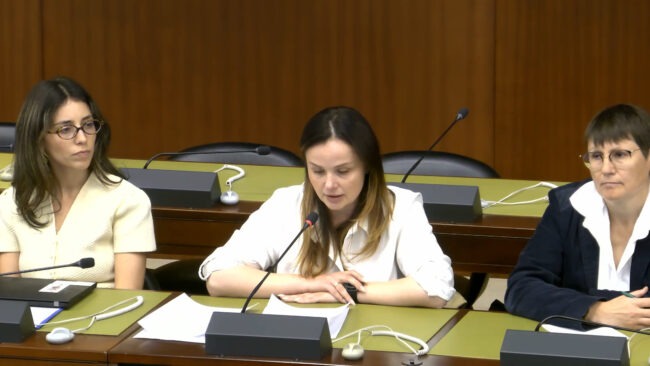
Kateryna Buriakovska spoke on behalf of the Kharkiv Human Rights Protection Group and ADC Memorial Brussels. Among the documented crimes committed by the Russian military and occupation authorities, she highlighted attacks on hospitals and maternity wards, enforced disappearances, various forms of violence, including sexual violence, perpetrated in places of detention, and different forms of gender-based coercion and violence under occupation. These violations have been documented across numerous regions of Ukraine, as well as in detention facilities in Russia and Russian-controlled occupied territories, indicating deliberate and systematic actions rather than isolated incidents or unavoidable consequences of war:
“I wish to highlight four patterns of violations documented in our submission.
First, maternity healthcare. We documented 34 incidents across 13 Ukrainian regions, including attacks involving precision-guided weapons and the forced removal of mothers and newborns from hospitals converted into military facilities. These incidents raise serious concerns about compliance with international humanitarian law, particularly the protection of medical facilities.
Second, enforced disappearances. We documented around 60 cases of missing women with indications of Russian involvement, including journalists, activists and healthcare workers. In one case, Russian authorities denied detaining a journalist despite video evidence of her arrest.
Third, sexual violence. Our 76 records represent only a fraction of the likely scale. They include rape, forced nudity, invasive searches and threats of sexual violence. We documented recurring patterns of such abuse across Russian detention facilities.
Fourth, coercion under occupation. Women face forced passportisation, prosecution for supporting Ukraine, forced displacement and threats involving their children. Our report documents mock execution of woman accompanied by threats to take away children, as well as cases of children transferred to Russia and not returned to their mothers.
In our report, we show how these violations, documented across different regions of Ukraine and Russian controlled institutions, point to deliberate and systematic practices rather than isolated incidents or inevitable consequences of war.
We urge the Committee to seek answers from Russia concerning these reported violations, to call upon effective investigations, accountability for perpetrators and remedies for victims. Russia’s obligations under CEDAW do not disappear during occupation. Neither should Ukrainian women disappear from international scrutiny.”
- The report “Violations of Women’s Rights Committed by the Russian Federation in the Territory of Ukraine (2022–2026)”
Oral Statement on the Situation of Indigenous Women Activists
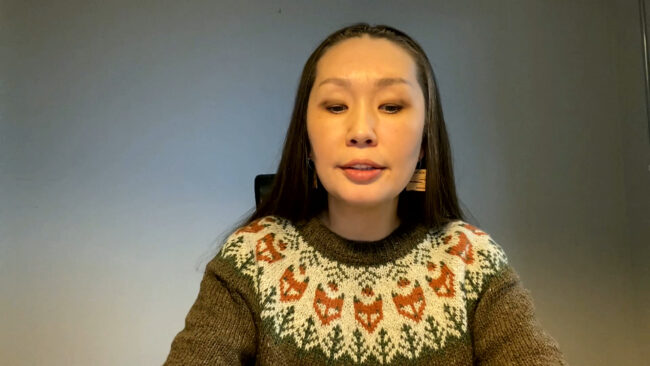
Yana Tannagasheva sent a short video statement on behalf of the International Committee of Indigenous Peoples of Russia, INFOE, North Women, and ADC Memorial Brussels. She emphasized that, in addition to the challenges faced by Indigenous communities in Russia—including difficult living conditions, the activities of extractive companies, access to education, and other issues—the most serious problem in recent years has been the persecution of Indigenous activists and organizations, including accusations of “extremism” and “terrorism.” She recalled that Daria Egereva and Natalia Leongardt remain behind bars, facing criminal prosecution for their peaceful work defending the rights of Indigenous Peoples, including at the UN level, and called for their immediate and unconditional release:
“Indigenous women and girls in Russia face systemic discrimination, dispossession and increasingly severe repression. Since CEDAW’s 2021 concluding observations, the situation has worsened. Across the North, Siberia and the Far East, extractive industries threaten our ancestral lands, livelihoods and cultural survival. Women defending these rights face intimidation and criminalization. Russia’s war against Ukraine has brought further suffering to Indigenous communities. Women are left grieving husbands, sons and brothers.
In 2024, Russian authorities designated independent Indigenous organizations as “extremist” and “terrorist” organizations. On the 17th December 2025, security forces targeted at least 17 Indigenous activists. Two women, Daria Egereva and Natalia Leongardt, were arrested. They remain detained and face up to twenty years in prison for alleged participation in a “terrorist organization”.
In our report, we formed a number of questions, and the most urgent question we urge CEDAW to ask Russia:
On what grounds are charges brought against peaceful women – Indigenous rights defenders, treating them as terrorists?
We demand their immediate and unconditional release. Defending our land is not terrorism. Defending our rights is not a crime.”
During its 93rd session, the UN Committee on the Elimination of Discrimination against Women (CEDAW) will draw up a List of Issues to be addressed to the Russian Federation during the review of its State party report at a future session.