ENG
 Feedback
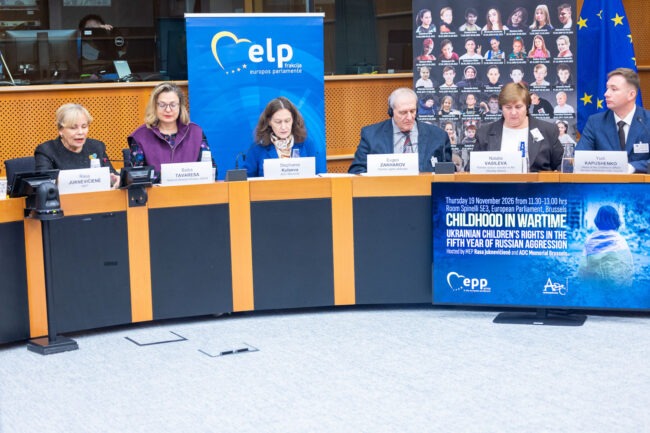
On 19 November, on the eve of World Children’s Day, the European Parliament in Brussels hosted the roundtable “Childhood in Wartime: Violations of Ukrainian Children’s Rights in the Fifth Year of Russian Aggression”. The event was organised by ADC Memorial Brussels and Member of the European Parliament Rasa Juknevičienė. The discussion was moderated by Rasa Juknevičienė and Stephania Kulaeva, Director of Anti-Discrimination Centre Memorial Brussels.
According to the Ukrainian state portal “Children of War”, 770 children have been killed and more than 3,018 injured since February 2022. Drawing on first-hand testimonies and expert perspectives, the participants discussed violations of children’s right to life, forced deportation, indoctrination and militarisation, as well as how the European Union can help protect Ukrainian children, bring deported children home and hold those responsible accountable.
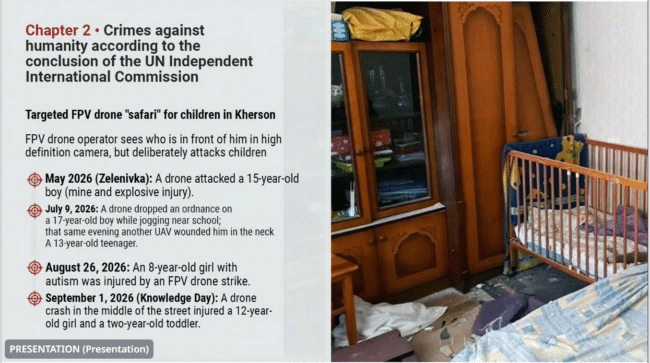
Yurii Kapushenko, Head of the Children’s Affairs Service of Kherson City Council, said that around 4,000 children remain in Kherson, a city separated from Russian positions only by the Dnipro River. Before the full-scale invasion, there were more than 50,000. Yet the number of injured children keeps rising: in 2026, 68 children have been wounded in the community, more than twice as many as in the whole of the previous year. In less than three years, Kherson has been struck with 349 guided aerial bombs, and Russian FPV drones attack children in the streets, near schools and even inside their own homes. As of 10 November, 737 children had been evacuated from the most dangerous areas of the community, and 67 still need to be taken to safety.
“For the children of frontline Kherson, even ordinary everyday activities can be a threat to life,” Yurii Kapushenko stressed.
The participants also spoke about children living under occupation.
“Children in the occupied territories are not only at risk of being killed by shelling. They also face indoctrination, militarisation and propaganda imposed by the occupying authorities. They are made to talk about it with their parents and then report back to school on how their parents reacted. All of this is directed by the Ministry of Education of the Russian Federation through the ‘Navigators of Childhood’ programme and special deputy directors sent to every school,” said Stephania Kulaeva.
Natalia Vasylieva, a former school director from Oleshky, described the lives of children on the occupied left bank of Kherson Oblast. Pupils are forbidden to speak Ukrainian, schools are guarded by Russian soldiers, and the occupying authorities are searching homes and checking the mobile phones of local residents. Her main request was for physical and psychological rehabilitation programmes for injured children.
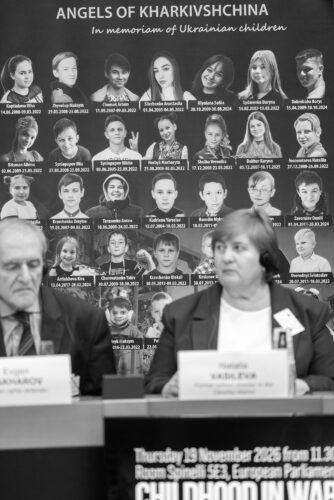
Human rights defender Evgen Zakharov presented the photo exhibition Angels of Kharkiv Region, dedicated to the memory of children from Kharkiv and Kharkiv Region who were killed in Russian attacks on civilians. The exhibition was initiated by Tetiana Matiash-Myrna, the mother of 11-year-old Mark, who was killed. The project was implemented by Kharkiv Human Rights Protection Group and the Kharkiv Regional Prosecutor’s Office with the support of the International Renaissance Foundation. First shown in Kharkiv, the exhibition is now travelling to cities across Europe to honour the memory of the children who were killed and to draw the international community’s attention to Russia’s war crimes against Ukraine.
“At the end of last year, when we opened our exhibition, 672 children had been killed across Ukraine. Today the number is 770. You can see for yourselves how quickly the number of children killed in this war is growing,” said Evgen Zakharov.
“Why did Russian soldiers kill our children? My answer is: only because they were Ukrainian. In Ukraine today there is no longer any doubt that this is a war to destroy the Ukrainian state and to physically destroy everyone who defends and supports it,” he stressed.
Baiba Tavaresa, Head of the Ukraine Division at the European External Action Service (EEAS), also took part in the discussion.
“Behind every such territory there are people. Handing them over to the Russian occupation regime means leaving them to repression, violence, the indoctrination of children and systematic human rights violations,” Rasa Juknevičienė stressed.
The recording of the discussion will be published on YouTube.
The publication is created in the framework of the project “Documenting and analysing international crimes committed by the Russia’s armed forces after 24.02.2022, helping victims of these crimes and informing on crimes” implemented by Kharkiv Human Rights Protection Group, Center for Civil Liberties and ADC Memorial Brussels, funded by the European Union.