


During the OSCE Warsaw Human Dimension Conference, the International Federation for Human Rights (FIDH) held a discussion on how “foreign agent” legislation and other repressive laws affect women, LGBTQ+ people, and other vulnerable groups, restrict their access to assistance and protection, and exacerbate their already vulnerable situation. The speakers discussed the situation in Russia, Georgia, Kyrgyzstan, and other Central Asian countries.
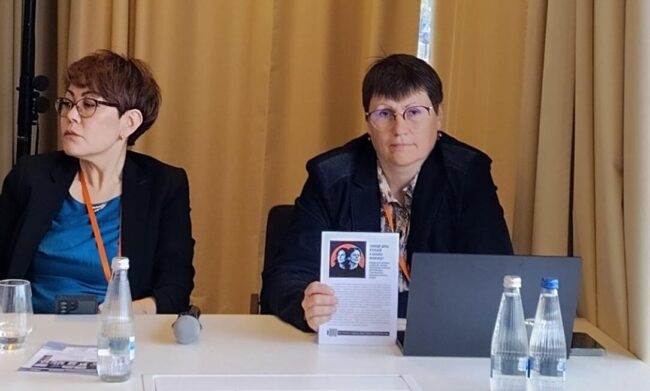

In her presentation, Olga Abramenko, an expert at ADC Memorial Brussels, focused on the impact of this legislation on Indigenous Peoples and ethnic minorities:
Anti-Discrimination Centre Memorial was one of the very first targets of the Foreign Agents Law back in 2013. Significantly, our report to the UN Committee Against Torture – which served as the pretext for the persecution – was entitled ‘Roma, Migrants, Activists: Victims of Police Abuse’. Thus, we were repressed precisely for our work on protecting the rights of minorities and vulnerable groups. More than 10 years have passed since then, and dozens of reports have been written on how repressive laws targeting civil society have changed, become harsher, come to apply to new various groups, and been adopted by countries dependent on Russia.
If we take, for example, a group such as Roma, the closure of our office in Russia has meant that systematic work to combat structural discrimination against the Roma has gradually come to a virtual standstill, whilst their problems remain unresolved.
As for Indigenous peoples of North, Siberia and Far East, despite the existence of specific protective legislation related to small-numbered Indigenous peoples and the institutions that have been established specifically for them, the actual participation of Indigenous peoples in matters directly related to them is limited.
Initially, the Foreign Agents Law affected environmental organisations and international foundations that were able to fund human rights and environmental projects. In other words, Indigenous communities themselves and their organisations were indirectly affected. But the Indigenous communities have lost access to expert support from human rights defenders, environmental specialists, anthropologists, and international foundations.
Over the past decade The Russian authorities’ repression against civil society has escalated, and such forms of persecution as recognition as a “foreign agent” have also affected Indigenous organizations. After the outbreak of Russia’s war against Ukraine, the persecution intensified, and in 2024 it reached the point that the leading formal and informal groups of Indigenous activists were first listed as “extremist” organizations (Aborigen Forum, International Committee of Indigenous Peoples of Russia, Indigenous Russia), and then as “terrorist” ones. It was the state’s response to anti-war protests and to attempts by activists from ethnic minorities and Indigenous peoples to initiate long-overdue public debate on issues that had been suppressed for decades: discrimination, colonization, the lack of genuine autonomy and federalism, and the state’s past and ongoing crimes against these peoples.
Military censorship deprives Indigenous communities of media access and of opportunities to publicly articulate their concerns. Contacts between Indigenous peoples of Russia and the international Indigenous community—including related peoples divided by state borders, such as the Sámi, Inuit, and Aleut—have been almost entirely severed.
Independent activists are being replaced by loyal representatives of Indigenous NGOs, which are in fact funded by the state and mining companies. At the international level, representatives of Indigenous GONGOs promote the positions of the Russian authorities and lobby for the lifting of sanctions against Russian businesses. Such organisations passed a transformation from independent agents of change into a tool of state propaganda. The control upon them is ensured not only through government pressure and the introduction of loyal leaders there, but also through the financing of the association by large mining companies. We see their dependence on business structures and lobbying in favor of large companies, affiliation with the United Russia party and government agencies, corrupt ties of officials who make money on the topic of Indigenous peoples.
In these circumstances, any participation in public, human rights, and political activities in the field of Indigenous peoples’ rights, can be outlawed, which opens up a huge field for manipulation by business structures and state authorities.
The criminalization of Indigenous civil activism and human rights work has become one of the most pressing consequences of Russia’s war against Ukraine, affecting all aspects of life for Indigenous peoples in both Russia and Ukraine. As early as 2014, following the annexation of Crimea, Russia banned the Meclis, the self-governing body of the Crimean Tatar people that had operated in Crimea since Ukraine’s independence, and apply mass repressions against Crimean Tatars.
In December 2025, repressive legislation was applied on a mass scale against Indigenous activists, including journalists and human rights defenders who had been active not only locally but also within relevant UN mechanisms. At least 17 activists in various regions of the Russian Federation were subjected to searches on suspicion of involvement in Aborigen Forum, an organization designated as “extremist” and “terrorist.” Facing the risk of 20 years of imprisonment, they had to emigrate.
Two activists, Natalia Leongardt and Daria Egereva, are still in a pre-trial custody, despite the international solidarity campaign for their release #FreeDariaAndNatalia. Daria Egereva is a well-known figure of the Indigenous movement, a member of the UN Indigenous Peoples’ Coordinating Body; since 2023, she has served as co-chair of the International Indigenous Peoples’ Forum on Climate Change.
We can see similar approach of the state to repressions against different groups; criminalization of a “movement”, arbitrary inclusion of persons or groups into “extremist or terrorist movement”, and then repression just for belonging to a group. Such development we saw in repression against LGBTIQ, or Indigenous peoples, or human rights defenders like Memorials, including my organization Anti-Discrimination Centre Memorial Brussels.