Feedback
ADC Memorial – Brussels, the International Committee of Indigenous Peoples of Russia, and the Institut für Ökologie und Aktions-Ethnologie have prepared a input for the UN Expert Mechanism on the Rights of Indigenous Peoples, focusing on the situation of indigenous peoples in armed conflict and post-conflict situations in the context of the Russian Federation’s military aggression against Ukraine.
Specific impacts of the current conflict on Indigenous peoples of Russia and Ukraine
In February 2022, Russia launched a full-scale invasion of Ukraine, openly continuing the anti-Ukrainian aggression started back in 2014, the involvement in which the Russian authorities for a long time denied. During the eight years preceding the invasion, Russia annexed Crimea and, as a result of the hybrid war, effectively seized significant portions of the Donetsk and Lugansk oblasts of Ukraine, installing unrecognised puppet republics in these regions. At the time of submission of this input, about 20% of the territory of Ukraine are under Russian occupation; They are subject to a harsh totalitarian regime and many repressive laws, which have been adopted by Russian lawmakers. All the traditional territories of the recognized Indigenous peoples of Ukraine – Crimean Tatars, Krymchaks, Karaites – have been occupied; some other territories are also affected, for instance many settlements of the North Azov Greeks have been entirely annihilated by Russian aggression.
The authors of this submission have previously informed various UN bodies about the unlawful policies of the Russian authorities towards ethnic minorities, migrants, and LGBTI+—state racism, xenophobia, and support for nationalist groups. These policies predictably culminated in open military aggression against Ukraine and failed to provoke meaningful resistance within Russian society.
In this context, the situation of the Indigenous peoples of Russia has its own specific features. On the one hand, peoples who do not belong to the Russian ethnic majority are experiencing racism and xenophobia, which in recent decades have shape the general societal climate in Russia, remain at a high level, and in recent years, according to some estimates, have been even growing further. On the other hand, Indigenous minority peoples—defined by a population of 50,000 people or less—are formally covered by special legislation, and Russian propaganda claims that the state devotes special ‘care’ towards small Indigenous peoples, although they are severely impacted by activities of extractive companies, globalization, and insufficient support measures, remaining one of the most vulnerable and impoverished groups of the Russian population. Special protective measures for Indigenous peoples are purely performative, lacking any robustness. For instance, Russia claims to observe the right to FPIC, yet Indigenous peoples in Russia neither are nor have ever been asked to give or withhold their consent prior to the granting of exploiting licenses for resources within their territories.
In the present context, the term ‘conflict’ therefore encompasses both the unresolved legacy of colonial policies pursued by the Russian Empire, the USSR, and the Russian Federation, and the ongoing military conflict between Russia and Ukraine, in which Indigenous peoples of Russia are heavily involved and from which they suffer disproportionately.
Russia’s aggressive war against Ukraine and its impact on the Indigenous peoples of Russia
Threats to the physical survival of Indigenous peoples and the preservation of their cultural and linguistic integrity
Conscription and the imposition of contract-based military service have mostly affected Russia’s poorest regions—precisely those where ethnic minorities and Indigenous peoples live. As a result, the latter groups bear a disproportionate burden of mobilization. For Indigenous peoples, participation in the war poses a direct threat to physical survival: the mobilization of large numbers of working-age men, combined with deaths and injuries sustained in combat, creates a real risk of demographic decline.
Military service normalizes violence. Upon returning to civilian life, survivors often suffer from post-traumatic stress disorder and other mental health conditions. For their family members, the risk of domestic violence and other violent crimes increases significantly. In Russia, at least 1,000 cases of murder and serious bodily harm committed by military personnel after returning home or while on leave have already been documented (Verstka investigation, December 2025).
In traditional communities, the departure of men to war places an excessive burden on women. This burden is compounded by the extreme climatic conditions in which many Indigenous communities live and by the heavy physical labor required to meet basic living needs, such as gathering firewood and maintaining traditional subsistence practices.
The sharp increase in Russia’s military spending and its economic isolation as a result of sanctions have led to economic stagnation and a decrease in the overall living standard nationwide, with especially severe effects in remote regions where Indigenous peoples live. Already among the poorest segments of the population before the war, Indigenous communities are now suffering disproportionately. This has direct and damaging consequences for families and for children.
Mobilization, fatalities, and long-term disability among men have particularly devastating consequences for Indigenous cultures, as men are the bearers of traditional knowledge in regard to hunting, fishing, and reindeer farming. Their removal from traditional activities disrupts the inter-generational transmission of traditionally male gendered knowledge, especially in small communities.
Rising environmental risks, negative climate impacts, and the collapse of international cooperation
The Russian authorities have been using the occasion of the war to demolish the few remaining mechanisms enabling Indigenous peoples to influence decision-making regarding their lands, territories and resources. This includes a new regulation that restricts participation in Ecological Expert Reviews (ekologicheskie ekspertizy) to hand-picked accredited experts, virtually excluding any independent opinions. Lacking the legal preconditions, most crucially, the recognition of Indigenous peoples as collective rights-holders with inalienable rights to their lands, territories and resources, there were no genuine FPIC processes in the country even before the full-scale aggression. The current climate of fear and intimidation means that no person will feel safe voicing objections against industrial projects and such objections are very unlikely to get duly recorded and reported.
As a result of sanctions, international and foreign extractive companies with comparatively higher environmental standards have withdrawn from Russia. They have been replaced by Russian companies and by companies from countries such as China, many of which are known for disregarding environmental protection on traditional lands and for ignoring the interests of local communities.
Indirectly, Russia obstructs progress on the global climate agenda by promoting pro-government positions internationally through controlled and loyal Indigenous organizations funded by the state and by extractive companies, including Norilsk Nickel. Russia also seeks to expand its influence through intensified engagement with Indigenous peoples of the Global South. At the same time, repression prevents independent representatives of Indigenous peoples of Russia from participating in UN bodies specifically dedicated to Indigenous issues, such as the Expert Mechanism and the Permanent Forum, or in forums related to Indigenous and climate concerns, including processes under the Convention on Biological Diversity. Those who do manage to attend international meetings often face verbal harassment from representatives of the Russian Federation and other agents of Russian influence.
Indigenous peoples have also lost access to expert support from human rights defenders, environmental specialists, anthropologists, and international foundations, many of whom have been targeted by repression or forced into exile. Military censorship deprives Indigenous communities of media access and of opportunities to publicly articulate their concerns. Contacts between Indigenous peoples of Russia and the international Indigenous community—including related peoples divided by state borders, such as the Sámi, Inuit, and Aleut—have been almost entirely severed.
Repressions against defenders of Indigenous peoples’ rights
The criminalization of Indigenous civil activism and human rights work has become one of the most pressing consequences of Russia’s war against Ukraine, affecting all aspects of life for Indigenous peoples in both Russia and Ukraine. This is particularly evident in relation to any claims to self-determination. As early as 2014, following the annexation of Crimea, Russia banned the Meclis, the self-governing body of the Crimean Tatar people that had operated in Crimea since Ukraine’s independence. Within Russia and in territories under its effective control, dissent is met with the threat of criminal prosecution and long prison sentences. Simultaneously, within the UN system, Russia advocates for the exclusion of Indigenous representatives based in third countries and beyond its control.
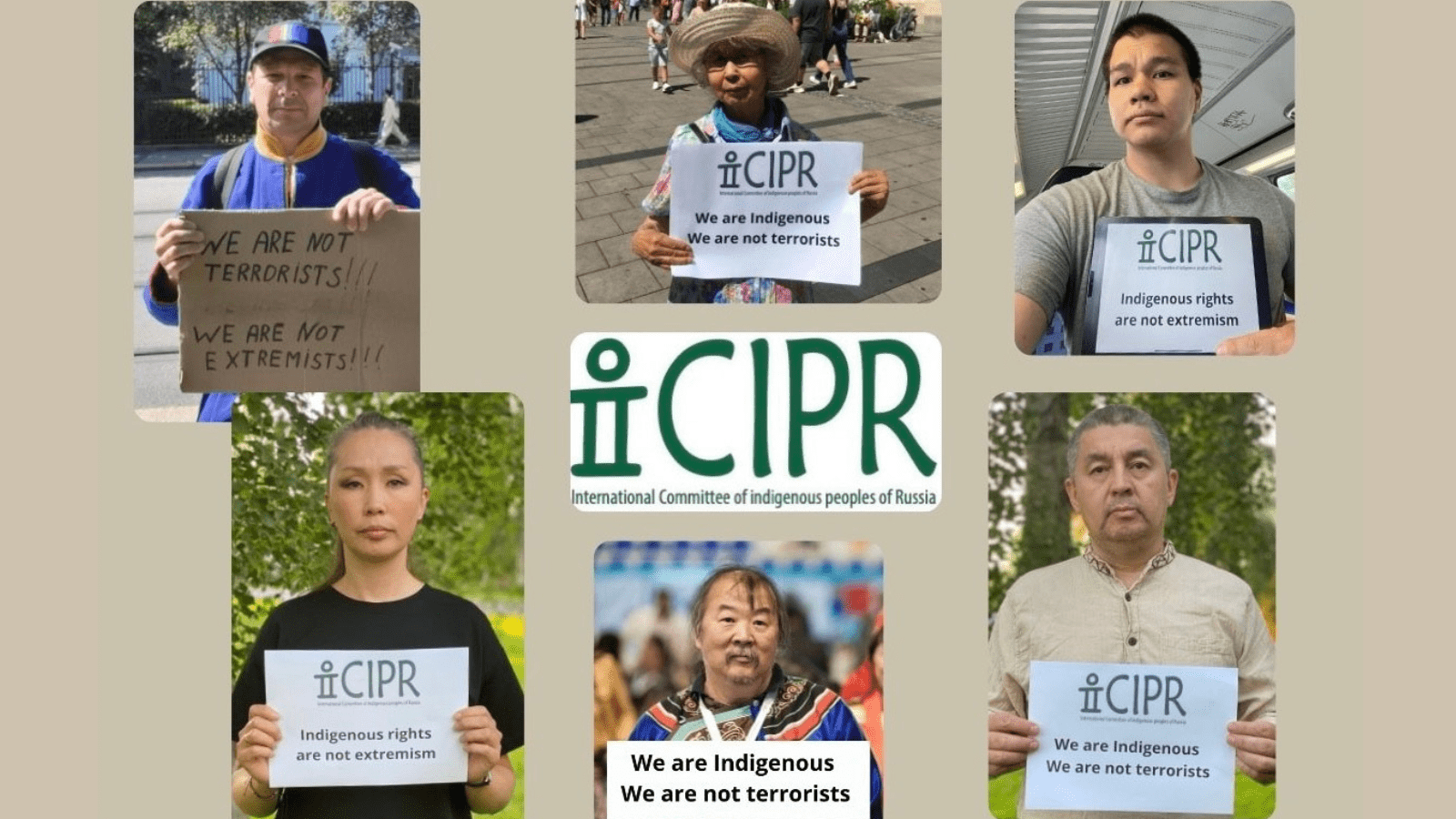
In 2024, both activists forced into exile and those who remained in Russia, along with their formal and informal organizations, were first designated as ‘extremist’ as part of a fictitious “Anti-Russian Separatist Movement”, and later as ‘terrorist’ allegedly as “structural units” of the discussion platform “Forum of Free States of Post-Russia”, itself declared a terrorist organization. These designations were entered into official state registers and included Indigenous rights organizations such as Aborigen Forum, the International Committee of Indigenous Peoples of Russia, and Indigenous Russia.
It was the state’s response to anti-war protests and to attempts by activists from ethnic minorities and Indigenous peoples to initiate long-overdue public debate on issues that had been suppressed for decades: discrimination, colonization, the lack of genuine autonomy and federalism, and the state’s past and ongoing crimes against these peoples.
In practice, only activists forced into exile are able to speak openly in defense of Indigenous peoples. Even they, however, face attacks and harassment on international platforms specifically intended to ensure Indigenous representation. Thus, after speaking at the 15th session of the Expert Mechanism on the Rights of Indigenous Peoples in July 2022 on behalf of the International Committee of Indigenous Peoples of Russia, Yana Tannagasheva was verbally attacked and intimidated by a diplomat from the Permanent Mission of the Russian Federation to the United Nations. Four UN Special Rapporteurs addressed this incident (Ref.: AL RUS 15/2022, 6 October 2022).
Repression has also targeted individuals expressing anti-war views, as well as regional activists campaigning against the dismantling of local self-government or in defense of natural territories.
Rafael Mammadov, a 24-year-old student, has been held in pre-trial detention in Murmansk since May 2025 on charges of participation in the so-called terrorist organization “Forum of Free States of Post-Russia,” with which he has no connection. He ran a small historical and cultural Telegram channel, “Free Lapland,” where he spoke out against the war. He faces up to 20 years’ imprisonment under Article 205.5 of the Criminal Code of the Russian Federation.
In September 2025, Aruna Arna, a mother of three and a leader of protests against the dismantling of local self-government and commercial development in the Altai Republic, was charged under Article 205.2(2) of the Criminal Code of the Russian Federation (“Public propaganda of terrorist activity on the Internet”) and placed in custody. She faces up to seven years in prison.
Dozens of criminal cases were opened against residents of the Baymak district in the Republic of Bashkortostan who protested in 2023–2024 against mining operations and environmental pollution. They were charged with mass disorder and violence against law enforcement officials, and hundreds of participants were subjected to administrative penalties.
In December 2025, repressive legislation was applied on a mass scale against Indigenous activists, including journalists and human rights defenders who had been active not only locally but also within relevant UN mechanisms. At least 17 activists in various regions of the Russian Federation (the Altai Republic; Tomsk, Murmansk, and Kemerovo Regions; Altai and Krasnoyarsk Krais; the Republic of Sakha (Yakutia); Moscow; and St. Petersburg) were subjected to searches on suspicion of involvement in Aborigen Forum, an organization designated as “extremist” and “terrorist.” Electronic devices and documents were seized. Those targeted face sentences of up to 20 years’ imprisonment.
All of these cases are linked to activist engagement, in various forms, with UN bodies dealing with Indigenous peoples’ rights. In Murmansk Region, for example, a search was conducted at the home of Valentina Sovkina, a prominent Sámi activist and member of the UN Permanent Forum on Indigenous Issues. She was subsequently forced to leave Russia and stated on 23 December 2025:
“We have to call a spade a spade: this is not a fight against terrorism, this is political revenge. This is a direct punishment from the state for the fact that representatives of Indigenous peoples dare to contact the UN, talk about violations of their rights, participate in the work of international bodies and tell the truth about what is happening in Russia. The Russian government is purposefully criminalizing the very idea of cooperation with the United Nations. Today, the space for free and independent opinion has been practically destroyed in Russia. Any criticism, any dissent, any independent social activity is severely suppressed. It is especially cynical that the attack is aimed at the most vulnerable — the Indigenous small-numbered peoples of Siberia and the Arctic, who are not socially protected, live in remote villages, in difficult conditions, have no political weight and are invisible to the “big society”. Our peoples cannot defend their rights except through international law. And that’s why we’re being punished today.”
Two female activists were placed in custody following these searches on charges of participation in the activities of a terrorist organization (Article 205.5(2) of the Criminal Code, carrying sentences of 10 to 20 years). One of them is Daria Egereva, a representative of the Selkup people. She is a member of the UN Indigenous Peoples’ Coordinating Body; since 2023, she has served as co-chair of the International Indigenous Peoples’ Forum on Climate Change; and in November 2025 she spoke at COP30 in Brazil.
Leading international human rights organizations have already spoken out in her defense. Thus, the International Indigenous Peoples’ Forum on Climate Change (IIPFCC) condemned her arbitrary arrest and demanded her immediate release. In its statement, the Forum called on all States parties to the United Nations Framework Convention on Climate Change (UNFCCC) and all allies of Indigenous peoples to show solidarity by:
1. publicly and privately calling for Ms. Daria Egereva’s immediate release and the dropping of all charges against her, which constitute unlawful retaliation for her legitimate and peaceful participation in COP30 and other UN processes.
2. registering her case as an instance of intimidation and reprisal related to participation in UNFCCC processes under the Code of Conduct for UNFCCC Events, and informing the IIPFCC of steps taken.
3. raising her case without delay with the Government of the Russian Federation through appropriate diplomatic channels, emphasizing that the criminalization of a UNFCCC Indigenous Co-Chair as a ‘terrorist’ is incompatible with the UNFCCC’s Code of Conduct and with Human Rights Council resolutions/determinations.
Conflict resolution and reconciliation processes in a post-conflict situation
In the current Russian context, initiatives geared at overcoming the conflict originate not with the state, but with civil society, while the state remains in denial of the legacy of colonialism and systemic discrimination against minorities. It persecutes activists who seek to address sensitive issues such as of regional autonomy, effective federalism, and self-determination of ethnic groups.
In April 2025, representatives of the Indigenous peoples of the North, Siberia and the Far East of the Russian Federation and of Russian civil society, all of them in involuntary emigration due to political persecution and/or their expression of anti-war sentiments, signed the Orcas Island Declaration: A Statement of Reconciliation and mutual Respect, so named after the location of the meeting – the territory of the Lummi nation, an Indigenous people of North America).
The Declaration was developed with the participation of Indigenous representatives, members of the Russian opposition, human rights defenders, experts, and lawyers, drawing on international experience in addressing colonial legacies, including the U.S. Congressional Resolution S.J.Res.14 (2009–2010), Canada’s Truth and Reconciliation Commission Final Report (2015), Norway’s National Truth and Reconciliation Commission report “Sannhet og forsoning” (2023), and reconciliation initiatives in Australia, including the work of Reconciliation Australia and the Uluru Statement from the Heart (2017).
The Orcas Island Declaration calls on Russian society to acknowledge past wrongs, to undertake an honest assessment of centuries of colonial policy toward the peoples inhabiting the territory of present-day Russia—above all small-numbered Indigenous peoples—and to initiate a reconciliation process grounded in international law, in particular the UN Declaration on the Rights of Indigenous Peoples.
The initiators of the Declaration have established a permanent platform for dialogue between representatives of the Indigenous peoples of the North, Siberia and the Far East and Russian civil society. As initial steps, it is propose to:
- conduct continuous monitoring of violations of the rights of Indigenous peoples of the North, Siberia and the Far East; provide assistance in protecting these rights; and communicate the results of this monitoring to the United Nations, other international organizations, and other relevant stakeholders;
- coordinate academic, educational and expert activities to analyze the consequences of colonial policies, restore historical memory, and study the challenges facing Indigenous peoples of the North, Siberia and the Far East.
- develop legislative initiatives and draft regulatory instruments aimed at restoring the rights of Indigenous peoples of the North, Siberia and the Far East.
- engage a broad range of participants—including representatives of the Indigenous peoples of the North, Siberia and the Far East, Russian civil society, scholars, politicians, human rights defenders, activists, journalists, and organize meetings, consultations, and other activities aimed at promoting reconciliation and the restoration of justice.
The participants in the Declaration are aware that currently, under the conditions of a de facto dictatorship, people of Russia cannot freely carry out these activities due to the risk of repression. Nevertheless, they emphasize the need to begin shaping the country’s future now, guided by the principles set out in the Declaration. In a future democratic context, the following steps are envisaged to ensure the recognition of Indigenous peoples’ rights:
- the establishment of a parliamentary commission to examine violations of Indigenous peoples’ rights, without regard to the statute of limitations.
- The preparation of a national report on colonization and violations of Indigenous peoples’ rights, similar to reports produced in Canada, Norway and Australia.
- the establishment of an independent body to consider Indigenous peoples’ claims to land and cultural rights.
- the adoption of legislation recognizing Indigenous peoples’ rights to their ancestral lands and natural resources.
The participants express their readiness to cooperate and to engage in sustained, consistent efforts to advance reconciliation, acknowledge historical injustice, and ensure the rights of the Indigenous peoples of the North, Siberia and the Far East.